
* Disclaimer – I am not a medical professional; anything I write about in this section is purely based on my own experience. If you experience new symptoms, please connect with your medical professional to best understand next steps *
A person with Multiple Sclerosis walks into a bar
and a chair
and a table…
Symptom Management looks different for everyone simply because symptoms are very rarely experienced the same way. A good example of this lies in my recent experience with Optic Neuritis – I occasionally (continue to) go blind in my left eye depending on the lighting around me, but others I have connected with have completely lost their vision in one eye and it has never returned.
I have personally been experiencing a flare for at least the last 2 months, though it could be longer. A quirk about my personal experience with MS lies in the fact that up until 2023, I rarely experienced standard systems and only kept tabs on my progression through my MRI scans every 6 months.
Since 2023, that has changed dramatically (with little having actually changed by my own doing), and I feel as though I’ve been thrown into the ring with minimal training, with the rest of my MS-having brothers and sisters out there.
So with this, I hope to share some of the mindful tips, habits, and practices I’ve introduced into my daily/weekly routines in order to maintain a quality of life that I personally need to keep my sanity.
- Daily Meditation: This one is everywhere, but it really has helped to brighten my perspective in my personal life! I come from a lineage of spitfire women who will fight for what’s important to us, with some pretty bad tempers. I have notoriously been easily triggered and continue to have a hard time managing my emotional control (if that resonates with you, check out my blog on mood swings I wrote during my time with the National MS Society!). Since finding meditation, I have practiced mindfulness throughout my day, without a ton of incremental effort. I meditate for 10 minutes a day, in bed, prior to going to sleep – I am not perfect, sometimes I fall asleep and need to re-meditate the same practice from the night before, but that is life – no one is perfect! All we can do is try, and give it our best effort. I use the app Calm, if you’d like to give it a try (John Armstrong is my favorite).
- Gratitude: Most folks will recommend writing down 3 things you’re grateful for in the morning or at the end of your day; I choose to write down 10! Some days are just business as usual – wake up, go to work, do some chores, make some dinner, go to bed, and do it all again. With a history of depression, it can be easy to fall into the “what’s it all for?” pattern; with expressing 10 things I’m grateful for, I end my days with a big smile, even if they are the simplest things. Whether I had a really meaningful connection with a friend, shared a meal with my partner, or simply got to enjoy a hot shower, it really drives home how much the little things matter.
- Daily Affirmations: I picked this habit up during a really dark period of my life, and if I’ve learned anything from this practice, it’s that you REALLY have to FEEL that your affirmations are TRUE. Affirmations are statements that begin with “I AM” and help to re-frame negative thoughts. I begin every single day with 3 affirmative statements ranging from financial health, mental health, and confidence boosters for my career. I’ve recently learned that this practice becomes useless unless you truly feel the power of your affirmations; with this, I’ve started actually speaking them out loud. It’s magical.
- Setting Intention: In becoming more mindful, I also hope to be intentional in all that I do. With permanently depleted energy stores, I don’t want to waste time spinning my wheels on something that isn’t actually going to benefit me in the end (or benefit someone else). I am a creature that lives by the magic of the (many) to-do list(s); under my 3 affirmations, I write out the list of tasks I hope to accomplish at home that day, ranging from my workout to house chores. In my phone, I have another to-do list based off of many thought dumps I have during the day. On my work computer, I have THREE to-do lists organized by which aspect of my job I am focusing on at that time. I aspire to have every moment of my life be a mindful moment, but it takes effort and a ton of practice. To help with this, I’ve recently picked up a practice discussed in James Clear’s Atomic Habits where I call out the action I am about to take. This has helped tremendously with binge eating practices I’ve had since I was a teenager and in justifying specific activities I am going to prioritize over other “productive” ones I should be doing (see my recent article on stress reduction).
- Reset between Tasks: Or simply put, properly transitioning between tasks. I realize that I become way more overwhelmed at work when I’m trying to multi-task on 5 different projects AND take zoom meetings AND answer direct messages. I have taken to the practice of transitioning between tasks to give my best effort in all that I do. It’s a work in progress as this is easier said than done, but it really does help. As discussed in Brendon Burchard’s book, High Performance Habits, taking just 1-5 minutes to close your eyes and take a few deep, mindful breaths before transitioning tasks can make a world of a difference. You can physically alter the persona you are going to show in this time; taking a few mindful moments in my car after arriving home from work allows me to transition from “Process Manager” to “Super-Fiancee-Dog-Mom” and walk through the threshold of our home with a cheery smile because I am not carrying the chaos of the day with me when I do so. Even taking a brief pause between finishing responding to emails and picking up the next documentation project on your list can not only enhance your focus, but provide a sprinkle of joy within the mundane task itself.
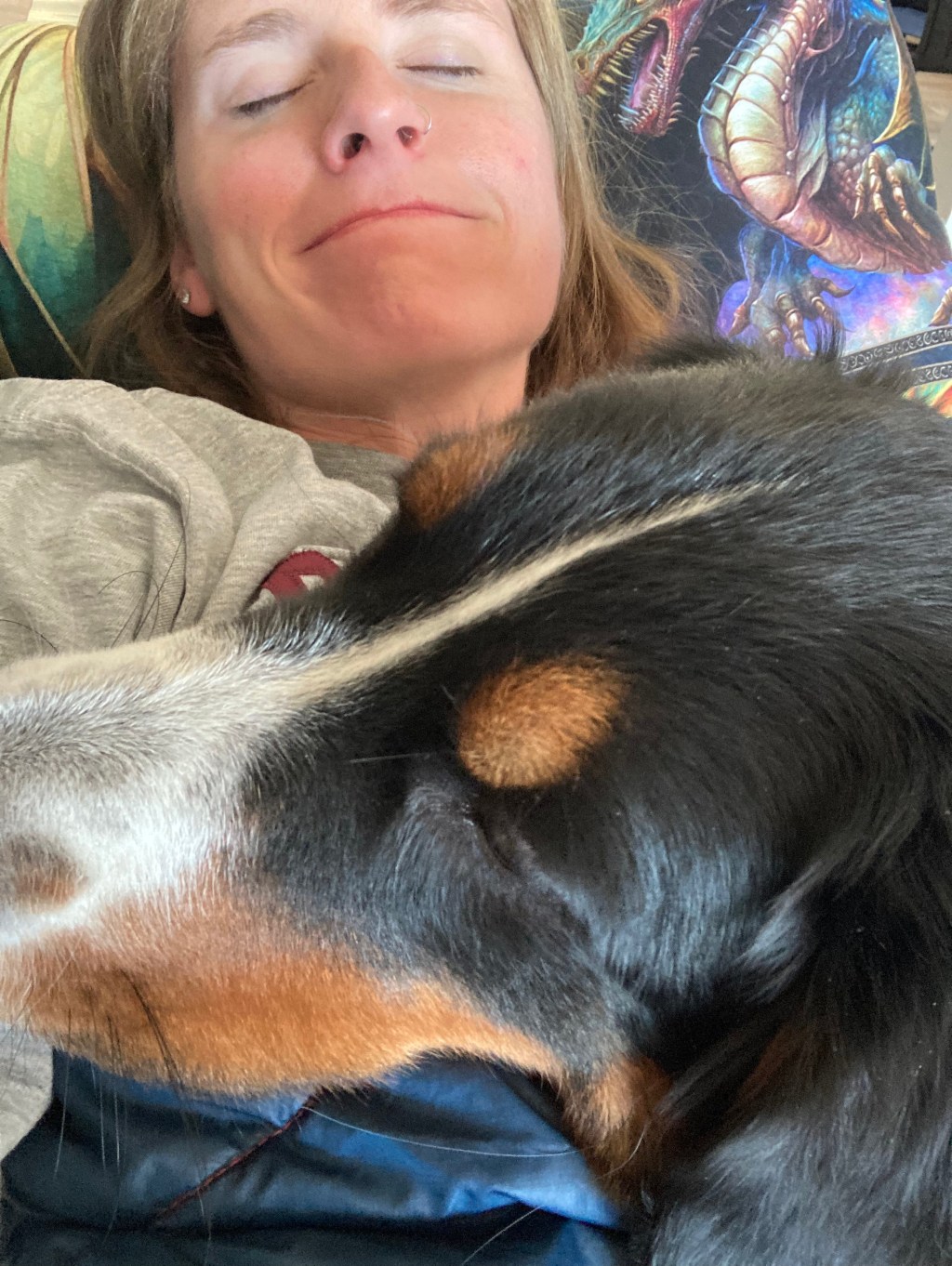
Mindfulness is one of my favorite ways to manage my symptoms because if I can’t physically do anything to ease my discomfort, at least I can take solace in knowing that I am doing something to benefit myself. We may not be able to completely take the pain away in the moment, but we can remain mindful in how we not only interact with others, but also ourselves. I invite you to try one of these tactics the next time you’re experiencing a heavy symptom day; it may just bring a smile to your face!






 Chronically Joyful
Leave a comment